

2026-09-22
Stadium lighting cost depends on the field size, required illuminance, pole layout, fixture quantity, total system wattage, controls and local installation rates. There is no reliable one-price answer for every project, but the running cost can be estimated with a simple formula:
Operating cost per hour = Total system power (kW) x Electricity rate per kWh
For example, a 24 kW LED stadium lighting system operating at an electricity rate of $0.15 per kWh costs approximately $3.60 per hour. This example excludes demand charges, taxes, maintenance and other local utility fees.
The total stadium lighting installation cost cannot be calculated from fixture wattage alone. A photometric plan or DIALux simulation is normally required to determine the correct number of fixtures, pole positions, beam angles, target lux level and uniformity.
| Project type | Typical design inputs | Main cost drivers |
|---|---|---|
| Community football field | Training or recreational lighting target | Field dimensions, existing poles and annual operating hours |
| School or club stadium | Competition requirements and spectator use | Uniformity, glare control, pole layout and controls |
| Professional stadium | Competition and broadcast requirements | High lux levels, vertical illuminance, flicker control and redundancy |
These categories describe design complexity, not fixed project prices. Equipment, freight, civil work, electrical labor, permits and site conditions vary by country and project.
Use the total input power of the complete lighting system, not only the rated power of one fixture.
Number of fixtures x Fixture wattage / 1,000 x Electricity rate = Cost per hour
Assume a football field uses 40 LED fixtures rated at 600 W each and the electricity rate is $0.15 per kWh:
40 x 600 W / 1,000 x $0.15 = $3.60 per hour
If the system operates for 800 hours per year:
$3.60 x 800 = $2,880 estimated annual electricity cost
This is an illustrative calculation. Actual energy use may change when dimming, scheduling or zoning controls are used. Local demand charges and power-factor requirements can also affect the bill.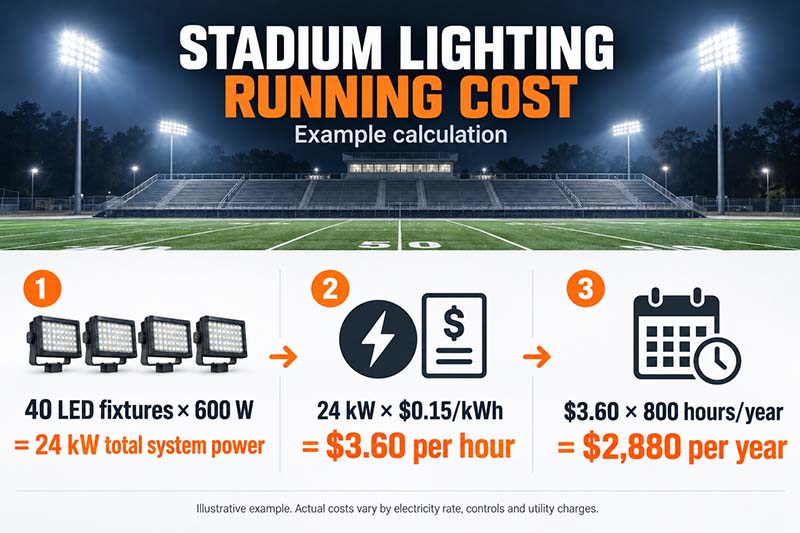
The main variables behind stadium lighting cost are:
LED stadium lights can reduce operating and maintenance costs when the new design uses less total system power and provides the required lighting performance. However, a one-for-one wattage comparison is not enough. The replacement ratio depends on fixture efficacy, optical distribution, pole layout, mounting height, target lux, uniformity and depreciation assumptions.
Compare both systems using a photometric design and total connected load. Also include warm-up and restrike behavior, dimming capability, lamp or driver replacement, cleaning access and expected maintenance labor in the total cost of ownership.
To prepare a useful football field lighting cost or sports field lighting cost estimate, provide:
With this information, fixture quantity and total wattage can be estimated more accurately through a DIALux lighting simulation.
Multiply the total system power in kilowatts by the local electricity price per kWh. A 24 kW system at $0.15 per kWh costs about $3.60 per hour before demand charges, taxes and maintenance.
There is no accurate universal price. Stadium lighting installation cost depends on field size, target lux, fixture quantity, pole work, foundations, cabling, controls, labor and local regulations. A site-specific lighting layout and quotation are required.
They often can when the proposed LED design lowers total system power and maintenance requirements while meeting the required lux and uniformity. Confirm the saving with a photometric plan and connected-load comparison.
The quantity depends on field dimensions, pole positions, mounting height, beam angles, target lux and uniformity. Fixture wattage alone cannot determine the correct number. A DIALux simulation is recommended.
Provide field dimensions, sport type, required lux, pole quantity and height, voltage, current fixture details, operating hours, drawings, photos and local electricity rate.
Send Unicornlite your field layout, pole information, lighting target and operating schedule. Our team can prepare a fixture proposal and DIALux simulation so you can compare stadium lighting installation cost, connected load and expected running cost using project-specific data.


